
![Upgrade to Premium Weight [18-gauge steel]](http://titancasket.com/cdn/shop/products/casketthicknesswithnumbers.png?v=1680642906&width=533)
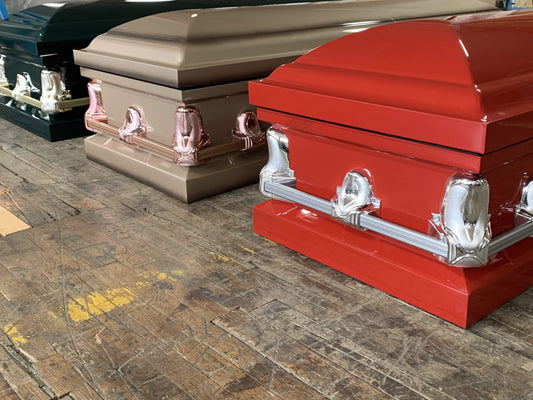
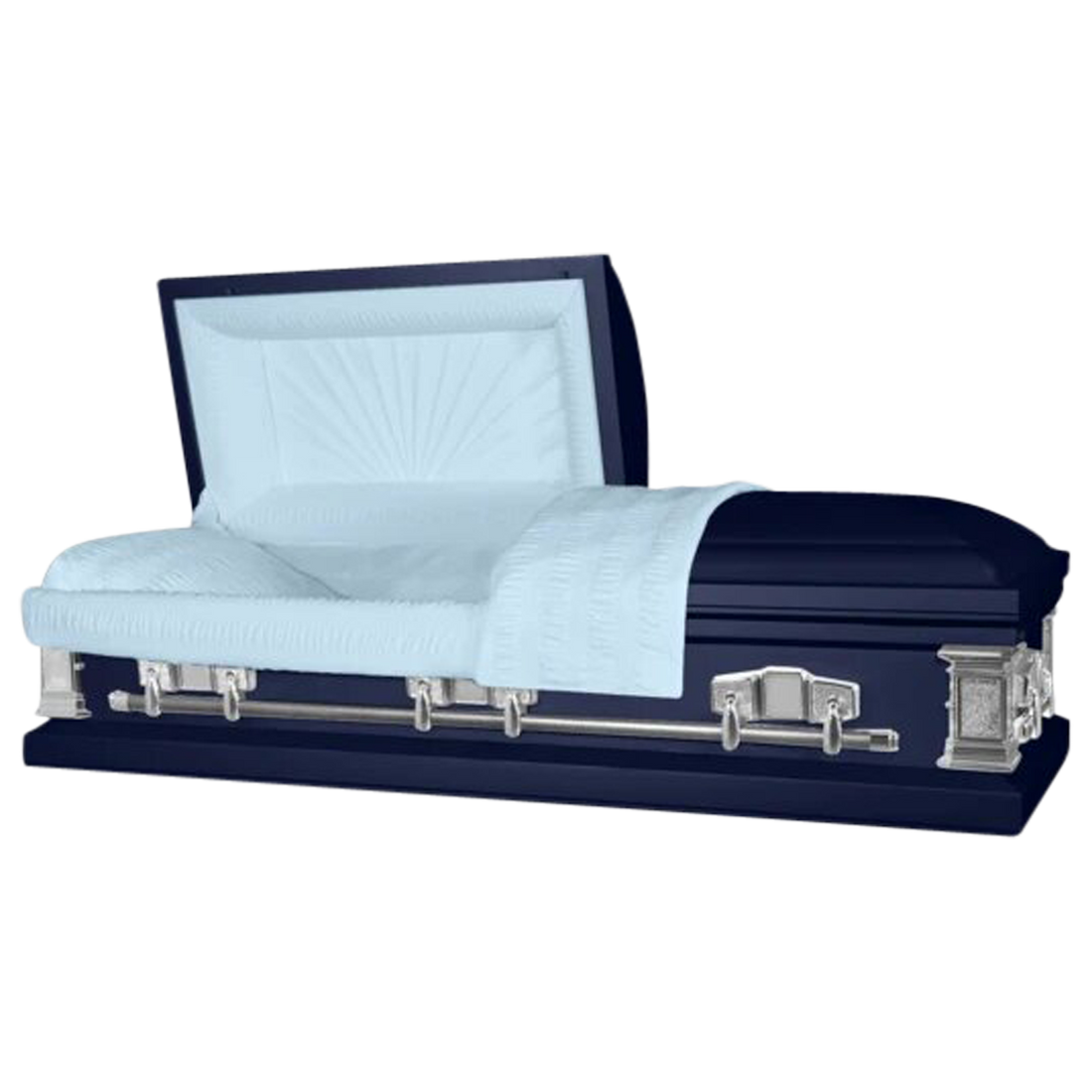
Caskets are grouped into three main types by material: metal caskets, wooden caskets and cloth-covered caskets. They also come in two shapes: the four-sided casket, which is standard in the United States, and the six-sided coffin, which tapers at the head and foot. Within those types, caskets differ by interior fabric, lid style and size. At Titan Casket, prices across all types run from $1,199 to $3,499 as of August 2026.
This guide walks through each casket type, what separates the styles, and what you can expect to pay. If you are making this decision now, you do not have to make it alone. Titan Concierge provides free funeral planning support that covers casket selection alongside the rest of the arrangements.
One thing worth knowing before you start comparing: under the Federal Trade Commission's Funeral Rule, you are legally entitled to buy a casket from any seller you choose. A funeral home must accept it and cannot charge you a handling fee for doing so. That single rule is what makes comparing casket types across suppliers worth your time.
Casket Types At A Glance
| Casket type | Made from | Best suited to | Titan price |
|---|---|---|---|
| Cloth-covered | Particle board wrapped in fabric | Simple services, tighter budgets, cremation | $1,199 |
| Softwood (pine) | Solid pine, no metal parts | Green burial, Jewish burial, cremation | $1,199 |
| Steel | Gauge steel, painted or finished | Traditional burial, open-casket viewings | $1,399 to $2,999 |
| Hardwood | Solid poplar or solid oak | Traditional burial where wood grain matters | $1,999 to $3,499 |
| Woven / wicker | Bamboo or willow | Green burial with a distinctive look | $2,399 |
Prices shown are Titan Casket's own, current as of August 2026, and are for standard-size caskets. Oversize models cost more. Prices at funeral homes for comparable caskets are typically several times higher, which is the main reason the Funeral Rule protection matters.
Casket Shapes: Casket vs Coffin
Shopping for a casket, you will notice "casket" and "coffin" used interchangeably. They are not the same shape. The difference between coffins and caskets comes down to the number of sides:
- Caskets are rectangular, four-sided burial containers, usually with exterior bars for pallbearers to carry. Caskets are by far the more common style in the United States and are what most American funeral homes display.
- Coffins are six-sided. They are widest at the shoulders and taper towards the feet, following the shape of the body inside. Coffins are more common in the United Kingdom, Ireland and much of Europe.
In everyday American usage the words are treated as synonyms, so a search for "coffin styles" and a search for "casket styles" will usually return the same products. The distinction only really matters if you specifically want the tapered six-sided shape.
Veteran Premier (Made in USA)
Sale price
$2,299
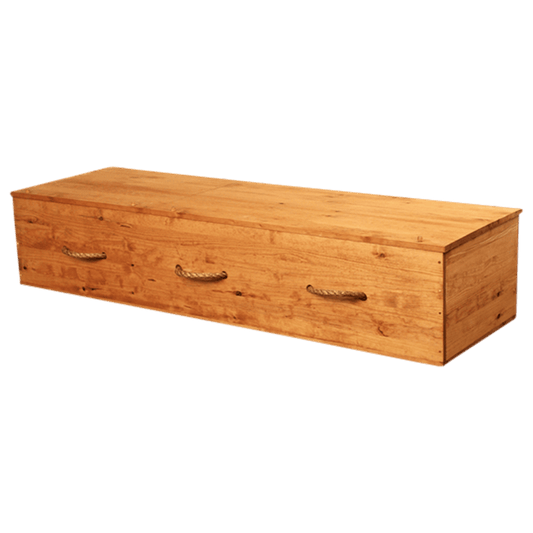
Eco II Pine Box (Made in USA)
Sale price
$1,199


Casket Types By Material
The exterior material is the single biggest factor in how a casket looks and what it costs. There are three main categories.
Metal Caskets

Metal caskets are made from steel and are the most common type sold in the United States. They are tougher and more dent-resistant than wood, and they take colour well, which is why steel caskets come in the widest range of finishes, from traditional silver, bronze and copper through to white, pink, royal purple and red.
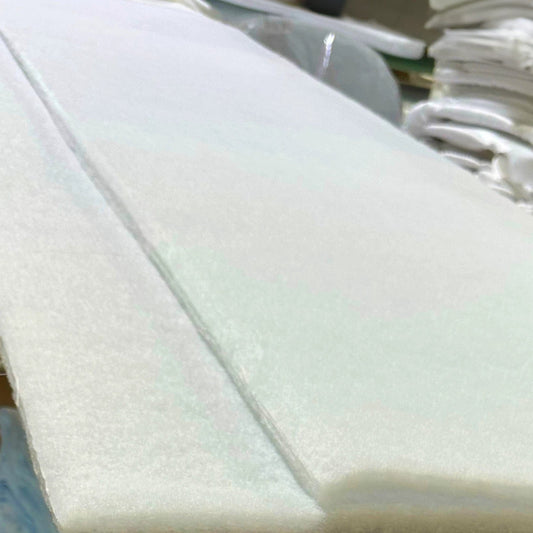
Steel caskets are described by gauge, which measures the thickness of the metal. Confusingly, a lower gauge number means thicker steel: 16-gauge steel is heavier and more substantial than 18- or 20-gauge. Thicker steel costs more. Titan's steel range runs from the Andover Series at $1,399 through the Orion Series at $1,599 to 16-gauge models such as the Matriarch starting at $1,999.
Many buyers add a rubber gasket to a metal casket, which seals the lid against dirt and moisture. It is important to be clear about what a gasket does and does not do: it resists the elements outside the casket, but it does not stop or slow decomposition inside it. The Funeral Rule specifically prohibits any seller from claiming that a casket or any feature of it will preserve a body indefinitely. Gaskets are not available on wooden caskets.
Wooden Caskets

Wooden caskets split into two groups, hardwood and softwood.
- Hardwood caskets are made from the wood of broadleaf, flowering trees: poplar, oak, maple, cherry, walnut and mahogany are all used across the industry. Titan's hardwood range is built from solid poplar and solid oak. It is worth understanding a distinction that trips a lot of buyers up: a casket sold as "mahogany" or "cherry" is very often a different species finished in a mahogany or cherry stain. Titan's Essex, for example, is solid poplar with a satin cherry finish, not cherry wood. If the species matters to you, ask the seller directly what the casket is built from rather than what colour it is called.
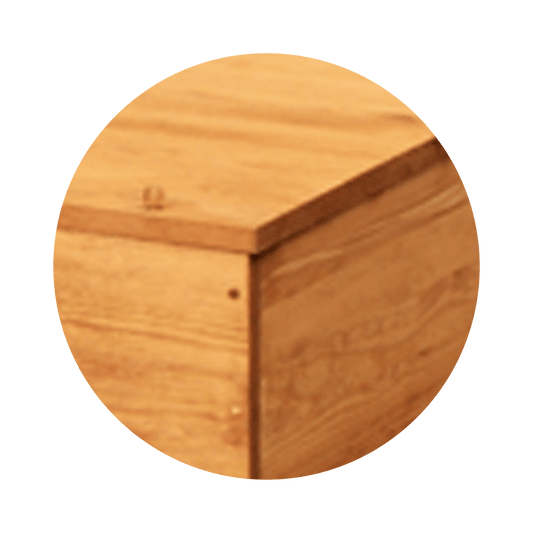
- Softwood caskets come from conifers, and in practice that almost always means pine. Titan's Eco Pine Box I and Eco Pine Box II are built with no metal parts at all, which makes them suitable for green burial, for Jewish burial, and for cremation.
Cloth-Covered Caskets

The Titan Rounded-Top Cloth Casket
Cloth-covered caskets are built from particle board and wrapped in a decorative fabric. They are the most economical type, and they are a genuinely common choice, not a compromise one. They suit simple graveside services, direct burials and cremation, and they present well at a viewing.
Titan offers cloth-covered caskets in flat-top and rounded-top styles at $1,199, with an oversize version at $1,499.
Casket Interiors: Crepe vs Velvet
The two most common casket interior fabrics are crepe and velvet, and the choice is purely aesthetic.
What's Inside A Casket?
- Crepe is made from silk, wool or synthetic fibre and has a distinctive crimped, matte texture. It reads as traditional and is the more understated of the two.
- Velvet is a cut-pile fabric, natural or synthetic, with a soft, dense, even surface. It looks richer and catches the light.
Inside the casket you will also find an adjustable bed and mattress, and on most models a head panel, the fabric panel visible in the open lid, which can be embroidered.
Plan Your Farewell with Grace – Our Pre-Planned Caskets Offer Peace of Mind
Casket Lid Styles: Half Couch vs Full Couch
Casket lids come in two styles, and the choice matters most if you are planning an open-casket viewing. Our guide to half couch and full couch caskets goes into more depth.
- Half couch lids are split into two hinged pieces. Only the upper section is opened, showing the head and torso while the lower body stays covered. This is by far the more popular style in the United States.
- Full couch lids are a single piece. When opened, the whole body is visible.
Casket Sizes
A standard adult casket has an interior width of about 24 inches, which fits most people comfortably. Oversize caskets are made in wider interiors (Titan's Poplar XL is 26 inches) for anyone who needs more room. Getting this right matters, because a casket that is too narrow cannot be exchanged at the last minute. If you are unsure, our guide on what size casket you need explains how to measure.
How Much Do Different Casket Types Cost?
Across Titan's range, the cheapest casket types are cloth-covered and pine at $1,199, mid-range steel sits between $1,399 and $1,999, hardwood runs from $1,999, and the most expensive standard models reach $3,499 for an oversize solid poplar casket.
The wider market looks very different. Funeral homes commonly mark caskets up substantially over wholesale, and the same casket type bought through a funeral home can cost several times what it costs direct. For a fuller breakdown of what caskets cost and why the numbers vary so widely, see our guide to how much a casket costs.
Cost is rarely the only pressure at this point. If you are trying to work out what to spend and where, Titan Concierge offers funeral planning services that include comparing costs across funeral homes before you commit.
Customizing A Casket
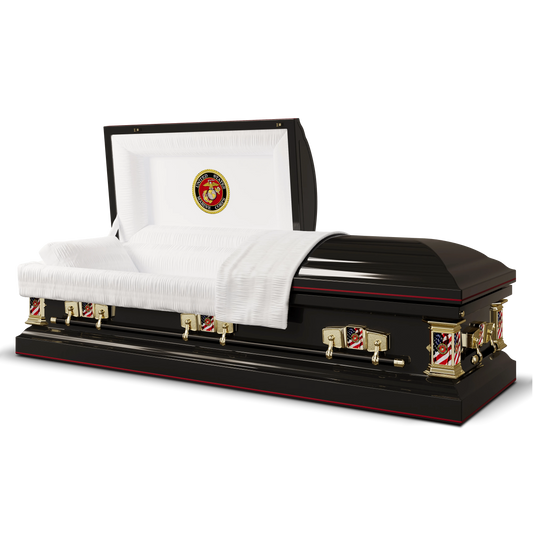
Most casket types can be personalised. The usual options are the exterior finish, the interior colour and fabric, hardware changes, embroidery on the interior head panel, and military or religious imagery on the corners or head panel. Titan can accommodate a wide range of casket customizations.
Casket Types: Common Questions
What are the three main types of caskets?
Metal, wood and cloth-covered. Metal caskets are made from steel, wooden caskets from hardwood such as poplar or oak or softwood such as pine, and cloth-covered caskets from particle board wrapped in fabric.
What is the difference between a casket and a coffin?
A casket is rectangular with four sides. A coffin is six-sided and tapers towards the feet. Caskets are standard in the United States; coffins are more common in the UK and Europe.
Which casket type is cheapest?
Cloth-covered caskets and plain pine caskets are the least expensive, both starting at $1,199 at Titan Casket. Steel and hardwood cost more.
Which casket type is best for a green burial?
A softwood casket with no metal parts, such as a pine box, or a woven bamboo or willow casket. Green cemeteries generally require fully biodegradable materials and no concrete vault.
Do sealed or gasketed caskets preserve the body?
No. A gasket resists moisture and dirt from outside the casket, but it does not prevent decomposition. The FTC Funeral Rule prohibits sellers from claiming otherwise.
Can I buy a casket somewhere other than the funeral home?
Yes. The FTC Funeral Rule requires funeral homes to accept a casket you bought elsewhere and prohibits them from charging you a handling fee for it.