
Introduction
Audrey Hepburn died at her home in Tolochenaz, a village on Lake Geneva, on 20 January 1993. She was 63. Four days later her coffin was carried out of the village church and up the slope to the cemetery a few hundred yards from the house, past several hundred people who had come to stand in the lane.
It was a small funeral for one of the most photographed women of the century. There was no studio service, no motorcade and no public viewing. The family held it in the Swiss village she had lived in since 1966, and buried her within walking distance of her own front door.
The Life and Legacy of Audrey Hepburn
Hepburn was born on 4 May 1929 in Belgium and spent the last winter of the Second World War in the Netherlands. She won the Academy Award for best actress for Roman Holiday in 1953, and went on to make Sabrina in 1954, Breakfast at Tiffany's in 1961, My Fair Lady in 1964 and Wait Until Dark in 1967. In 1966 she moved her family to Tolochenaz, and she kept the house there for the rest of her life.
The work she gave her last years to was UNICEF, the agency that had helped feed her as a child in occupied Holland. As a Goodwill Ambassador she travelled to Ethiopia, Turkey, Venezuela, Ecuador, Guatemala, Honduras, El Salvador, Bangladesh, Thailand, Viet Nam and Sudan. In September 1992 she visited camps of starving Somalis in Kenya and Somalia. That December, President George Bush presented the Presidential Medal of Freedom at the White House without her, telling the East Room that by doctors' orders she was unable to join us. She had six weeks left.
Let Titan Concierge help you plan with clarity, care, and confidence.
The News of Audrey Hepburn's Passing
A UNICEF spokesman in New York announced the death, saying she had died peacefully at her home in Switzerland surrounded by her loved ones. In Tolochenaz a relative who answered the door confirmed it, and a black bordered notice went up on the village notice board. The Associated Press and UPI both carried the news the same day.
She died of cancer. She had been treated after returning from Somalia, when abdominal pain that was first put down to a virus or a parasite turned out to be a malignant tumour, and surgery in November 1992 was followed by two more operations that found the disease had spread too far to treat. The rare condition behind it, pseudomyxoma peritonei, which affects roughly one person in a million each year, was named years later in an account published with her son Sean Hepburn Ferrer. Nothing fuller was made public.
The Funeral Arrangements for Audrey Hepburn
The funeral was held on Sunday 24 January 1993 at the village church in Tolochenaz, in the canton of Vaud. It was a Reformed Evangelical church in the village where she had lived for 27 years, and the service was arranged in the four days between her death and the burial.
It was kept deliberately small. The Associated Press reported about 120 friends and family inside the church, with about 500 other people, most of them local, gathered outside and listening to the service on loudspeakers. There was no second memorial in Los Angeles or London, and no public ceremony of any kind followed.
The Casket Details of Audrey Hepburn
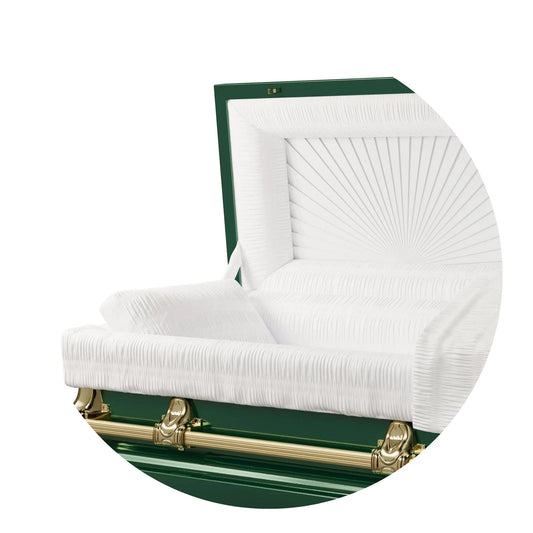
She was buried in an oak coffin. The Associated Press described it being carried from the church to the cemetery by pallbearers led by her two sons, Sean Ferrer, then 32, and Luca Dotti, then 22. No maker, model, interior or price has ever been made public, and for a funeral this private it probably never will be.
Other famous funerals went the other way. Aretha Franklin was buried in a solid bronze casket plated in gold, and Muhammad Ali in a cherry red one draped in cloth worked with Arabic script, while Alex Trebek had no casket at all. Hepburn's was hardwood rather than metal, the oldest division there is among celebrity casket types, and oak is still one of the commonest woods in caskets and coffins today.
Attendees and Eulogies
Prince Sadruddin Aga Khan, the former United Nations high commissioner for refugees, gave the eulogy in the church and spoke about how she had reached out to people in the refugee camps she visited. Sean Ferrer spoke as well, about his mother's belief that love could heal and mend. Both men had worked alongside her, Sadruddin through the United Nations and Ferrer as the son who travelled with her.
Her companion of the last years, Robert Wolders, attended, as did both of her former husbands, the actor Mel Ferrer and the psychiatrist Andrea Dotti. Roger Moore, Alain Delon and Hubert de Givenchy, the designer who had dressed her since Sabrina, were among the friends in the church.
The Impact on Fans and the Industry
The crowd in the lane outside was the part the public actually got. Around 500 people stood through the service in the lane, most of them from the village and the surrounding area, and one of them told a reporter she had come because she loved the films and because Hepburn had loved Switzerland. Nobody organised it and nobody ticketed it.
The tributes came from two directions at once. Elizabeth Taylor paid tribute within hours, and so did James Grant, then the head of UNICEF. One was a friend from the same era of Hollywood, the other the man who had sent her to Ethiopia and Somalia, and between them they covered the two halves of a life that had split neatly down the middle.
Legacy and Remembering Audrey Hepburn
Her grave sits in the Tolochenaz cemetery on ground that looks down over the village, the lake and across to Mont Blanc. In the days after the burial the marker was a plain wooden cross, put there as a temporary one, which is close to the unmarked plot where Steve Jobs was buried.
She left no public instructions about any of it. Alan Rickman planned his own funeral and Elizabeth Taylor left written instructions that delayed the start of hers by fifteen minutes, both decisions of the kind now made through casket pre-planning and funeral planning. What Hepburn left instead was the record of where she had been and what she had asked for on behalf of children, which UNICEF still publishes. Jane Goodall, another British woman who spent her last decades campaigning and died far from home, had an urn rather than a casket at her service more than thirty years later.
-
Catima's Choice
Orion Series (Made in USA)
Regular price $1,599Regular priceUnit price per -
Orion Series (Made in USA)
Regular price $1,599Regular priceUnit price per -
Orion Series (Made in USA)
Regular price $1,599Regular priceUnit price per


Conclusion
Audrey Hepburn's funeral was four days in the making, held in a village church, attended by about 120 people, and finished with an oak coffin carried uphill to a hillside grave. The scale of it was the point. She had spent the last years of her life in places where almost nothing was available to anyone, and she was buried with almost nothing at all.
Her family chose that privacy, as other families have since. Helen McCrory had no service at all, and Diane Keaton was cremated three days after she died with no public funeral, memorial or viewing. Hepburn got a church, a coffin, a hillside and five hundred neighbours in the lane, which was more than either of them and a good deal less than her fame could have filled.
Sources
- UPI, "Actress Audrey Hepburn dead at 63", 20 January 1993
- Associated Press, "Actress Audrey Hepburn is dead of cancer at 63", Deseret News, 21 January 1993
- Associated Press, "Hepburn eulogized as a star who exuded love and warmth", Deseret News, 25 January 1993
- Associated Press, Audrey Hepburn obituary, The Roanoke Times, 21 January 1993
- UNICEF, Goodwill Ambassadors: Audrey Hepburn
- Public Papers of the Presidents of the United States: George H. W. Bush, remarks on presenting the Presidential Medal of Freedom, 11 December 1992, via GovInfo
- Encyclopaedia Britannica, Audrey Hepburn
- CBS News, "Almanac: Audrey Hepburn"
- SWI swissinfo.ch, "Swiss sanctuary of a very fair lady"
- Health Awareness, "23 years since his mother's death, Sean Hepburn Ferrer shares her legacy of hope", 20 December 2018