

Introduction
Muhammad Ali spent years deciding how he wanted to be buried, and in June 2016 his family carried out the plan almost exactly as he left it. There was a Muslim prayer service in the arena where he had his first professional fight, a nineteen mile drive through the streets he grew up on, a burial in a Louisville cemetery he picked out himself, and a public memorial that anyone could walk into for free. Very few famous people get the funeral they actually designed. Ali did.
He was 74 when he died in Arizona on 3 June 2016, and the send-off ran across two days the following week. Thursday belonged to the prayer service. Friday belonged to the city, the grave and the arena. Much of what people saw had been settled years earlier by Ali himself, down to the religions represented on the stage and the kind of cloth he was wrapped in.

The Life and Legacy of Muhammad Ali
He was born Cassius Marcellus Clay Jr. in Louisville, Kentucky, in January 1942, and he won a gold medal at the 1960 Olympic Games in Rome while still a teenager. He took the world heavyweight title at twenty two by beating Sonny Liston, joined the Nation of Islam in 1964, and changed his name. Over a twenty one year professional career he compiled a record of 56 wins and 5 losses with 37 knockouts, and he became the first man to win the world heavyweight title three times.
He took that third title back from George Foreman in the Rumble in the Jungle on 30 October 1974, then defended it ten times, including the Thrilla in Manila on 1 October 1975. Away from boxing he lived with Parkinson's for more than three decades, and he kept working through it. On 9 November 2005 he received the Presidential Medal of Freedom at the White House, honoured, in the words of the citation, for his lifetime of achievement and his principled service to mankind.
Let Titan Concierge help you plan with clarity, care, and confidence.
The News of Muhammad Ali's Passing
Ali died on Friday 3 June 2016 at a hospital in the Phoenix area of Arizona. He was 74. He had been admitted with a respiratory problem, and his children travelled to be with him. The following day the family spokesman, Bob Gunnell, held a news conference in Scottsdale and said Ali had died of septic shock due to unspecified natural causes.
Gunnell's statement described the end of a thirty two year fight with Parkinson's disease, which Ali had been diagnosed with in 1984, at the age of 43. Nothing about the death was disputed, and no inquest or investigation followed. Instead of flowers, the family asked people to give to the Muhammad Ali Center in Louisville.
The Funeral Arrangements for Muhammad Ali
The arrangements were Ali's own. He worked on them for years with a small circle that included Gunnell, his attorney Ron Tweel and the Islamic studies scholar Dr Timothy Gianotti, and the plan grew so thick that the group called it "The Book". Gunnell has said it ran to about two inches when it was presented to Ali in 2010, that Ali read it over roughly a week, and that he approved it in writing. One piece of it was dropped at the last moment. A public lying in repose at the Muhammad Ali Center had been in the plan for years, but the family worried about the crowds it would draw, so a long procession through the city was put in its place.
The first service was the Jenazah, the traditional Muslim funeral prayer, held on Thursday 9 June 2016 at Freedom Hall in Louisville. The venue was deliberate. Ali had his first professional fight and first professional win there in 1960. It was open to anyone who wanted to come, and the Muhammad Ali Center puts the attendance at more than 14,000. Imam Zaid Shakir led the prayers and the scholar Sherman Jackson spoke. There was no stage and no altar. Those who spoke stood on the floor in front of a black curtain, beside the casket, which was turned to face Mecca.
The Casket Details of Muhammad Ali
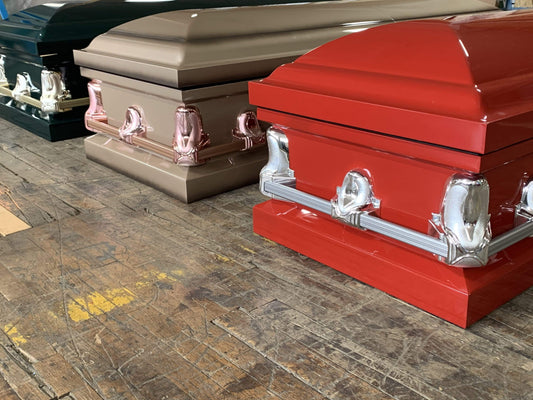
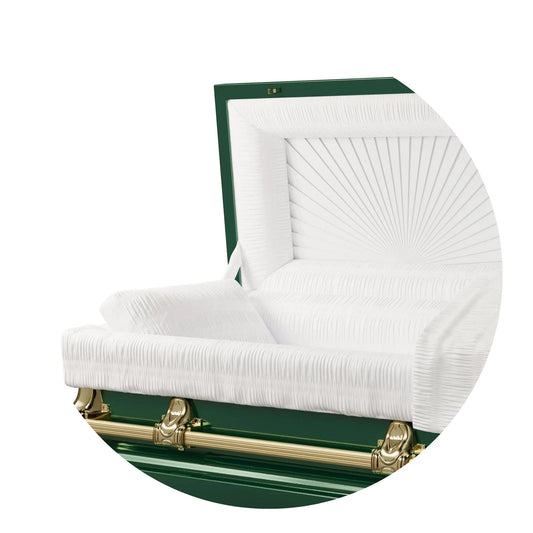
Ali's casket was cherry red, and before the procession it was draped with an Islamic cloth worked in Arabic script and carried out to the hearse by his pallbearers. No maker, model, material or price has ever been made public, and after a family led funeral built around religious tradition it probably never will be. What was described was the covering rather than the box, which is in keeping with a Muslim burial, where plainness is the point.
The preparation of the body followed the same tradition. Gianotti said that he, Imam Shakir and two Muslims from the Phoenix area washed, anointed and wrapped Ali within a day of his death, in the simple cloth known as a kaffan. The Muhammad Ali Center says that Ali and his wife Lonnie had quietly arranged that burial shroud themselves years earlier, without telling anyone. A cherry red casket under an Arabic inscription and a plain linen shroud are two ends of the same tradition, and the range of celebrity casket types runs between them, from the heavy hardwood and metal caskets of a state style funeral to the simpler coffins that suit a service like Ali's.
Attendees and Eulogies
The public memorial began at 2pm on Friday 10 June 2016 at the KFC Yum! Center in downtown Louisville, with free tickets given out first come, first served, and about 15,000 people inside. Former President Bill Clinton gave the eulogy. Billy Crystal, who had known Ali for decades, drew laughter with an impression of Ali and the sportscaster Howard Cosell, and the journalist Bryant Gumbel also spoke. Ali had asked for a service with more than one faith in it, and clerics from several religions took part alongside the imam leading it.
His family spoke too. His wife Lonnie Ali addressed the arena, as did his daughters Maryum and Rasheda. Attallah Shabazz, the eldest daughter of Malcolm X, read poetry and named all nine of Ali's children. Rabbi Michael Lerner and the Louisville pastor Kevin Cosby spoke, and Valerie Jarrett read a letter from President Barack Obama, who could not attend. Senator Orrin Hatch was there, along with Spike Lee, Jim Brown, Arnold Schwarzenegger, David Beckham, Whoopi Goldberg and Kareem Abdul-Jabbar.
The Impact on Fans and the Industry
The procession was the part that belonged to everyone. The hearse took a nineteen mile route through Louisville that passed his childhood home in the West End, Central High School, Muhammad Ali Boulevard and the museum that carries his name, and an estimated 100,000 people lined it. They chanted his name, ran alongside the car, and threw so many flowers at the windscreen that the driver had to clear them away to see the road. Pallbearers included the former heavyweight champions Lennox Lewis and Mike Tyson, who flew in overnight after wondering whether he would be able to hold himself together, and Will Smith, who had played Ali on screen.
For anyone who could not get to Kentucky, both services were streamed, the same answer that later let people watch Jane Goodall's funeral in Washington from anywhere in the world. The week left its own small record behind. The Muhammad Ali Center says that in the eight days following his death, Louisville authorities recorded no violent crimes at all.
Legacy and Remembering Muhammad Ali
The burial itself was private. The drive ended at Cave Hill Cemetery in Louisville, a place Ali had chosen roughly a decade before he died, and only his widow, his nine children and other relatives were at the graveside. Gunnell said the marker would be a simple headstone carrying one word, Ali, in keeping with Islamic tradition. That restraint puts him close to Steve Jobs, buried under no marker at all, and a long way from the solid bronze casket, plated in gold, chosen for Aretha Franklin. The grave sits in a public cemetery and people still visit it.
On the same day as the funeral, 10 June 2016, the United States Senate agreed to Senate Resolution 489, honouring his life and achievements, submitted by Senators Hatch, Booker and McConnell. Ali belongs to a small group who settled their own arrangements in advance, with Alan Rickman, who planned his service himself, Elizabeth Taylor, who left written instructions for hers, and Luke Perry, who chose the way he was buried. Choosing the covering while you are well, as Ali and Lonnie did with the kaffan, is the whole idea behind casket pre-planning, and the rest of what Ali put in The Book, the venue, the speakers and the order of the day, is the ground covered by funeral planning.
-
Catima's Choice
Orion Series (Made in USA)
Regular price $1,599Regular priceUnit price per -
Orion Series (Made in USA)
Regular price $1,599Regular priceUnit price per -
Orion Series (Made in USA)
Regular price $1,599Regular priceUnit price per


Conclusion
Ali's funeral worked because he had thought about it for years and because the people around him stuck to what he asked for. A prayer service open to anyone, in the hall where he first fought for money. A slow drive past his old front door. A private burial under a stone with one word on it. A public memorial where the tickets cost nothing.
Pelé lay in state in his old stadium while a country filed past, then was buried privately. Freddie Mercury was sent off by the rites of his own faith, in private, with almost no one there. Ali had both, the vast and the plain, three days apart, and he had written down which was which.
Sources
- Associated Press, "Muhammad Ali died from septic shock, family spokesman says", 4 June 2016, via PBS NewsHour
- Al Jazeera, "Death of Muhammad Ali: Boxer died of septic shock", 4 June 2016
- Associated Press, "Ali scripted funeral plans in exacting detail in 'The Book'", 6 June 2016, via the Daily Herald
- Associated Press, "Ali remembered in prayer as an icon who pushed for unity", 9 June 2016, via The Spokesman-Review
- Associated Press, "Muhammad Ali's Muslim prayer service draws 14,000", 9 June 2016, via The Christian Science Monitor
- Associated Press, "'Ali! Ali!' The Greatest is laid to rest in Louisville", 10 June 2016, via Global News and NBC New York
- ABC News, "Farewell to 'The Greatest': Thousands Celebrate Muhammad Ali's Life", 10 June 2016
- Sky Sports, "Muhammad Ali laid to rest in huge Louisville funeral", 10 June 2016
- CBS Sports, "Thousands turn out to pay respect to Muhammad Ali at memorial service", 10 June 2016
- Sports Illustrated, "Mike Tyson added to pallbearers at Muhammad Ali's funeral", 10 June 2016
- WTVR, "Muhammad Ali dies at 74", 4 June 2016
- The Muhammad Ali Center, "Muhammad Ali's Celebration of Life"
- U.S. Senate, S. Res. 489, 114th Congress, agreed to 10 June 2016, via GovInfo
- The White House, Office of the Press Secretary, "President Awards Presidential Medal of Freedom", 9 November 2005
- U.S. National Archives, African American Heritage: Muhammad Ali, and Rediscovering Black History, "Tribute: Muhammad Ali, 'The Greatest'", 6 June 2016
Image credits
- Muhammad Ali receiving the Presidential Medal of Freedom, White House, 9 November 2005. Photographer: George W. Bush White House Photo Office. Source: U.S. National Archives and Records Administration, National Archives Identifier 7431423. Licence: public domain, a work of the United States federal government not eligible for copyright protection under 17 U.S.C. 105.