
Introduction
Wilt Chamberlain was found dead in bed at his home in the Bel Air hills of Los Angeles on Tuesday 12 October 1999. He was 63. The Los Angeles Police Department said he had apparently died of natural causes and had been under medical care for a heart related condition. Four days later about 800 people filled a church in Los Angeles to remember him, and later that month Philadelphia, the city that made him, held a service of its own.
He was cremated, so there was no casket. No urn has ever been described and no resting place has been made public. What the record does hold is two memorials in two cities, for a man both of them claimed.
The Life and Legacy of Wilt Chamberlain
Chamberlain was born in Philadelphia on 21 August 1936. He did not start playing basketball until seventh grade, and the Associated Press reported that he grew four inches in three months at 15 and stood 6 feet 11 by the time he reached Overbrook High School. There he led the team to three public school championships and two all city titles, and more than 200 colleges came after him. The Pennsylvania state historical marker dedicated to him opens by calling him a legendary basketball player, born in Philadelphia.
He chose Kansas, where he spent three years, one on the freshman team and two on the varsity, and lost the 1957 national championship game to North Carolina in triple overtime. He turned professional with the Harlem Globetrotters in 1958 and played in the NBA from 1959 to 1973 for the Warriors, the 76ers and the Lakers. On 2 March 1962 he scored 100 points against the New York Knicks at Hersheypark Arena in Pennsylvania. He was most valuable player four times and won championships with the 76ers and the Lakers. The Associated Press put his career totals at 31,419 points and 23,924 rebounds, and reported that he never fouled out of a game in more than 1,200 regular season and playoff appearances. Kansas Athletics records that he died shortly after seeing his jersey retired in Allen Fieldhouse.
Let Titan Concierge help you plan with clarity, care, and confidence.
The News of Wilt Chamberlain's Passing
The Los Angeles Police Department set out what happened in a release issued the next morning. Officers were called to the 15200 block of Antelo Place in West Los Angeles at about 12:30pm on 12 October for what was logged as a possible ambulance death investigation. Joe Mendoza, who had been Chamberlain's grounds keeper for more than sixteen years, found him in bed and called paramedics when he did not respond. Los Angeles Fire Department paramedics pronounced him dead at 12:41pm. The department said he had apparently died of natural causes and had been under medical care for a heart related condition.
Sy Goldberg, his attorney and agent and a friend of forty years, said the cause was congestive heart failure, and that for about a month doctors had been draining fluid from Chamberlain's legs caused by the heart problem. On the day itself officials would say only that there were signs of a heart attack. The heart and the circulation are what took Elizabeth Taylor and Lucille Ball as well.
The Funeral Arrangements for Wilt Chamberlain
There was no funeral in the churchgoing sense, no procession and no lying in state. Chamberlain was cremated, and the public farewell was a memorial service held on Saturday 16 October 1999 at the City of Angels Church of Religious Science in Los Angeles. It ran about ninety minutes and drew roughly 800 people. Two photographs stood at the front of the room, the famous one of him holding a sheet of paper reading 100, and a colour picture of him in a Lakers jersey.
Nothing Chamberlain himself wanted for the day has ever been made public, and no instructions of his have surfaced in the years since. Elizabeth Taylor and Muhammad Ali had both settled theirs in advance, which is the work of choosing a casket ahead of time and setting out a funeral in advance.
The Casket Details of Wilt Chamberlain
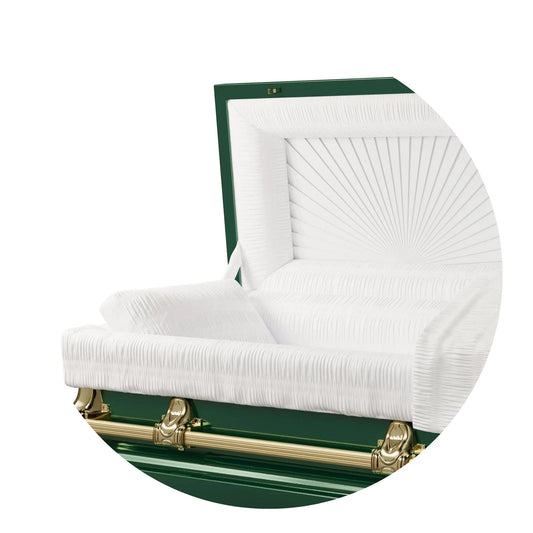
There is no casket to describe. Chamberlain was cremated, which both ESPN and CBS News reported at the time, and nothing about an urn, its material, its size or its design has ever been made public. Neither has a resting place. No cemetery, no plot and no marker has been named by his family or by any credible outlet in the quarter century since, and for a man of his fame that silence has held unusually well.
A casket or an urn becomes a matter of public record only when a service is open or televised, or when a family decides to describe it, and neither happened here. The casket types that do get named are drawn from the same range of caskets, coffins and cremation urns any family is offered. Diane Keaton and Burt Reynolds are in the same position, with nothing about the container released at all.
Attendees and Eulogies
Most of what was said in Los Angeles was about the man rather than the numbers. Meadowlark Lemon, his Harlem Globetrotters teammate, said Chamberlain had lived his life to the fullest. Bill Russell, who had spent a career on the other side of him, said Chamberlain had sent him through hell on many nights but that it had been a competition rather than a rivalry, and that the two of them would be friends through eternity. Goldberg called him a great human being who happened to play basketball. Bernie Casey, the former footballer, remembered him as inquisitive and intelligent and full of trivia, and Tommy Hawkins pointed out that the record book still belonged to him. His sister Barbara Lewis spoke about his generosity and about their childhood, and David Shaw, who had co written his first autobiography, told a story about a boat. ESPN reported that Alex Hannum, Elgin Baylor, Connie Hawkins, Bob Lanier, Nate Thurmond, Bill Walton and Jerry West were all in the room.
Russell wrote his own farewell nine days later. In a eulogy published by Time on 25 October 1999 he described meeting Chamberlain when Chamberlain was a sophomore at Kansas and he was starting out with the Celtics, and said the public picture of the two of them as enemies had been far from the truth. He wrote about late night phone calls in which they talked about politics and spirituality rather than basketball, and about a shared understanding that came from more than height. Basketball, he said, was only what they did.
The Impact on Fans and the Industry
The second farewell was Philadelphia's, and it was the one that felt like a hometown funeral. CBS News reported a memorial service held later in October at a church a few blocks from Overbrook High School, where more than 500 people came and the mood ran closer to laughter than to tears. Mayor Edward Rendell told the room that Chamberlain had never really left Philadelphia even when he was geographically far away. The Temple coach John Chaney remembered taking his shots as a schoolboy. Tom Gola said Chamberlain's true height was 7 feet 1 and three quarter inches and that he had measured it himself with a ladder at training camp. Paul Arizin spoke about his generosity. Vince Miller, his best friend for more than fifty years, called him a confidante and said he would love him forever.
Two cities, two services and no funeral between them is a shape other families have ended up with as well. Mary Tyler Moore was buried quietly while the public grief gathered somewhere else entirely, and John Candy had a closed service in one country and a public farewell in another. George Foreman, a sportsman with the same kind of civic following, was mourned in one city and laid to rest in a different one.
Legacy and Remembering Wilt Chamberlain
The honours had mostly come while he was alive, and some of them came late. The 76ers raised his number 13 to the rafters of the Spectrum on 18 March 1991, eighteen years after he retired, at a forty five minute ceremony before a home game against Orlando. United Press International reported that he had been honoured at Overbrook High earlier the same day, and that he asked the crowd to read the retired number as a symbol of his friendships rather than of his scoring and rebounding. Kansas retired his jersey in Allen Fieldhouse in January 1998, and he stayed three hours afterwards signing autographs.
What came after his death was put up in Philadelphia. The Commonwealth of Pennsylvania dedicated its historical marker to him on 28 September 2000, at 59th and Lancaster. In June 2004 an eighteen foot bronze by the sculptor Omri Amrany was unveiled at the southeast corner of the Wells Fargo Center, commissioned by the Wilt Chamberlain Memorial Fund, which was co chaired by Billy Cunningham and Steven Cozen. The Association for Public Art records that the plaque at its base reads "The worth of a man is measured by the size of his heart". In December 2014 the Postal Service issued two Wilt Chamberlain forever stamps, printed at twice the usual commemorative length to match his height, and WHYY reported that Overbrook High School held a dedication ceremony of its own. A statue or a plaque is what people visit when there is no grave to stand at, which is how fans of Eddie Van Halen and of George Harrison ended up too.
-
Catima's Choice
Orion Series (Made in USA)
Regular price $1,599Regular priceUnit price per -
Orion Series (Made in USA)
Regular price $1,599Regular priceUnit price per -
Orion Series (Made in USA)
Regular price $1,599Regular priceUnit price per


Conclusion
Wilt Chamberlain died at home of what the police called natural causes, and what his agent called congestive heart failure. He was cremated. There was no casket, no urn anybody has described, and no grave anybody can visit, so a man who spent his life in front of enormous crowds left nowhere for them to come and stand.
What his family did not give the public, two cities built themselves. A memorial in Los Angeles where his rival called him a friend for eternity, a service in Philadelphia a few blocks from his old school where the mayor said he had never really left, a historical marker, an eighteen foot bronze outside the arena, and a stamp twice the normal size. Pelé and Aretha Franklin were mourned on that civic scale too, in places that treated the death as the city's business as much as the family's.
Sources
- Los Angeles Police Department, "Wilt Chamberlain Dies of Natural Causes", news release, 13 October 1999
- ESPN, "Chamberlain towered over NBA", 14 October 1999
- ESPN, "Russell calls Wilt an eternal friend", 16 October 1999
- CBS News, "Wilt Chamberlain Remembered", 16 October 1999
- CBS News, "Still Remembering Wilt", 21 October 1999
- Associated Press, "Basketball great Chamberlain found dead at 63", 13 October 1999
- Deseret News, "Wilt: 1936-1999, Chamberlain among few whose fame transcended the sport", 13 October 1999
- Lawrence Journal-World, "Wilt the Stilt dies at 63", 13 October 1999
- The NCAA News, Rich Clarkson remembrance, 25 October 1999
- Time, Bill Russell, "Eulogy: Wilt Chamberlain", 25 October 1999
- United Press International, "Chamberlain's No. 13", 18 March 1991
- The Philadelphia Inquirer, column on the death of Wilt Chamberlain, republished 12 October 2017
- Pennsylvania Historical and Museum Commission, Wilt Chamberlain state historical marker, dedicated 28 September 2000
- Association for Public Art, Wilt Chamberlain (2004) artwork record
- WHYY, "Overbrook H.S. celebrates stamp honoring famous alum Wilt Chamberlain", 10 December 2014
- Kansas Athletics, "Tribute to Former KU Great Wilt Chamberlain", 25 August 2006