

![Upgrade to Premium Weight [18-gauge steel]](http://titancasket.com/cdn/shop/products/casketthicknesswithnumbers.png?v=1680642906&width=533)
A graveside service is a short funeral ceremony held at the burial site itself, usually lasting 15 to 30 minutes, at which the casket is committed to the grave. It can be the only service a family holds, or the final stop after a church or funeral home service. This guide explains what happens at a graveside service, how to plan one step by step, what a typical order of service looks like and what to expect on the day.
What Is A Graveside Service?
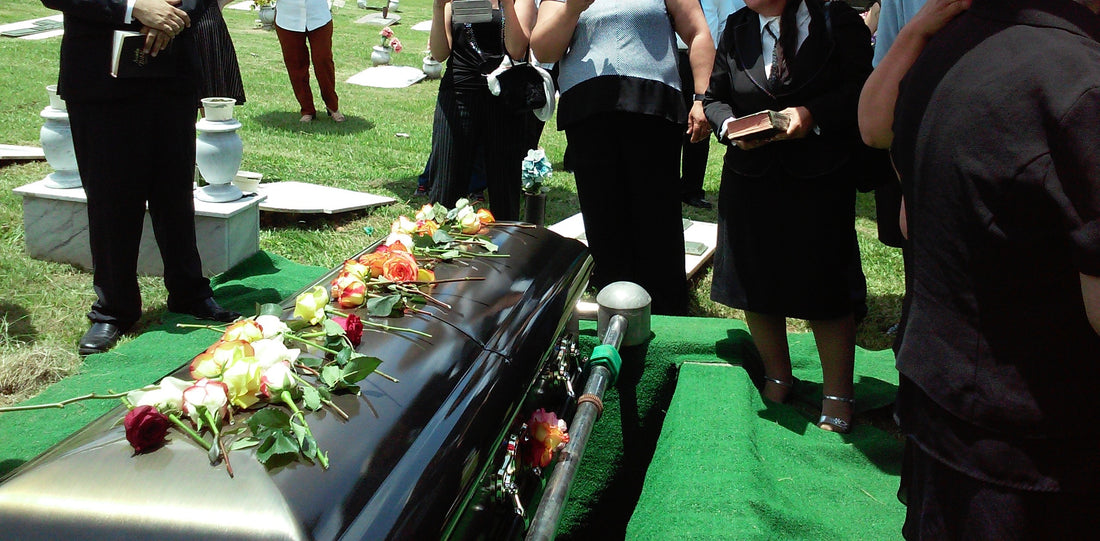
A graveside service, also called a committal service or burial service, takes place beside the open grave at the cemetery. Mourners gather around the casket, a family member or officiant leads a brief ceremony, and the casket is lowered into the ground either during the service or after guests leave.
There are two common formats. In the first, the graveside service follows a full funeral elsewhere and only close family and friends travel to the cemetery, often in a procession behind the hearse. In the second, the graveside service replaces the funeral entirely. This "graveside only" option has become far more common because it is simpler, shorter and considerably cheaper than a funeral with a separate venue, viewing and procession. You can compare the numbers in our guide to how much a graveside funeral costs.
Plan Your Farewell with Grace – Our Pre-Planned Caskets Offer Peace of Mind
Graveside Service Vs Funeral Vs Memorial Service
The three are easy to confuse. A funeral service is held with the body present, usually at a funeral home or place of worship, and often lasts an hour or more. A memorial service is held without the body present, frequently after cremation, and can take place anywhere at any time. A graveside service is held at the grave with the casket present and is the shortest and simplest of the three. Families sometimes combine them, for example a memorial gathering at home a few weeks after a private graveside burial.
How Long Does A Graveside Service Last?
Most graveside services run 15 to 30 minutes. A service with military honors, several readings or a religious rite such as the Catholic Rite of Committal can stretch to 45 minutes. Cemeteries schedule burials back to back and grounds crews wait to close the grave, so officiants keep things concise. Guests should plan to stand for the whole service unless the family arranges seating, which is one of the practical reasons these ceremonies stay short.
How To Plan A Graveside Service: Step By Step
Planning a graveside service comes down to seven decisions. Most can be made in a day or two. A funeral director handles the licensed parts, and a funeral concierge can walk you through the options, compare cemetery and vendor prices and flag hidden fees before you commit.
1. Choose the cemetery and the plot
If your loved one pre-purchased a plot, the cemetery already has the paperwork. If not, you will need to buy one. Prices, rules and availability vary widely, so read our guide to how to buy a cemetery plot before you sign anything. Ask specifically whether the cemetery requires a burial vault or grave liner, because most do and it is a separate cost.
2. Buy the casket
The casket is typically the largest single purchase in a burial. Under the FTC Funeral Rule, a funeral home must accept a casket you buy elsewhere and cannot charge a handling fee for doing so, which is why many families order directly from a manufacturer such as Titan Casket and have it delivered to the funeral home or cemetery. Our guide to casket types and prices covers the options.
3. Set the date and time with the cemetery
Cemeteries need notice to open the grave, and many restrict burials to weekday mornings and early afternoons, with extra fees for Saturdays. Confirm the arrival time, where cars should park, whether the crew will lower the casket during the service or after, and what happens if the weather turns. Ask what the cemetery provides: most set up a canopy, artificial grass over the soil and a lowering device, and some offer a few chairs for immediate family.
4. Choose who will lead the service
A clergy member, a celebrant, the funeral director or a family member can officiate. For a religious service, contact the church, synagogue or mosque early because clergy schedules fill quickly. For a non-religious service, a confident family member or friend is often the best choice. If nobody in the family wants to speak, a professional celebrant can run the ceremony and the family can simply attend.
5. Decide the order of service
Write it down and share it with the officiant and anyone reading. A sample outline follows in the next section. Keep the number of speakers to two or three; standing mourners, wind and traffic noise make long programs hard to follow.
6. Arrange transport, flowers and pallbearers
Decide whether the hearse will bring the casket directly to the cemetery or lead a procession from a funeral home. Choose six pallbearers to carry the casket from the hearse to the grave, or ask the funeral home to provide them. Order a casket spray and any standing arrangements to be delivered to the cemetery, not the home. If the deceased was a veteran, request military funeral honors through the funeral director; the honors detail, flag and playing of Taps are provided free by the Department of Defense.
7. Tell people where to go
Include the cemetery name, section and any gate or parking instructions in the obituary and in messages to guests. Cemeteries are large and unfamiliar, and a wrong turn can mean missing a 20-minute service. If you are also planning a reception, list its address and time as well.
Graveside Service Order Of Service (Sample Outline)
A typical graveside service outline, whether religious or secular, follows this sequence:
- Arrival and procession: the hearse arrives, pallbearers carry the casket to the grave and place it on the lowering device. Family stands or sits nearest the casket.
- Opening words: the officiant welcomes guests and explains briefly what will happen. About two minutes.
- Reading or prayer: a scripture passage, poem or short reflection. Common choices include Psalm 23, "Do Not Stand at My Grave and Weep" and readings from the deceased's own faith tradition.
- Eulogy or remembrance: one or two short tributes, three to five minutes each.
- Words of committal: the officiant formally commits the body to the ground. In Christian services this is the "earth to earth, ashes to ashes, dust to dust" passage; in a Jewish service, mourners recite the Mourner's Kaddish and each shovel earth onto the casket; in a secular service, the officiant may simply invite a moment of silence.
- Military honors, if applicable: the honor guard folds and presents the flag to the next of kin and Taps is played.
- Final gesture: guests place a flower on the casket, drop a handful of soil into the grave or file past to say goodbye. The casket may be lowered now or after guests leave, depending on the family's wishes.
- Closing and dismissal: the officiant thanks guests and announces any reception. Immediate family often stays a few minutes after the crowd disperses.
-
Atlas XL (Made in USA)
Regular price From $1,999Regular priceUnit price per -
Cambridge Series (Made in USA)
Regular price $2,799Regular priceUnit price per






What To Expect At A Graveside Service
If you are attending rather than planning, a few practical points help. Arrive 10 to 15 minutes early and park where the cemetery staff direct you. Dress as you would for a funeral, but choose flat shoes that will cope with grass and soft ground. Turn your phone off. Stand a respectful distance from the grave and let immediate family occupy the front. If the family invites guests to drop soil or a flower on the casket, take part; if they do not, wait for the dismissal. Expect the ceremony to be brief and to include a few moments of silence while the casket is lowered. Our guide to funeral etiquette covers what to say and what to avoid.
Graveside Service Ideas To Personalize The Ceremony
Because it is short and outdoors, a graveside service lends itself to simple personal touches: a favorite song played from a portable speaker, a bagpiper or bugler, a dove or butterfly release, guests each placing a single stem on the casket, a reading in the language of the deceased's heritage, or a hand-dug shovel of earth from a place that mattered to them. For a veteran, the flag presentation and Taps are often the most memorable moment of the day. Whatever you choose, tell the officiant in advance so it fits naturally into the order of service.
Graveside Service FAQs
Can you have a graveside service without a funeral?
Yes. A graveside-only service is a complete, legal and increasingly common option. The body goes from the place of death (or the funeral home) directly to the cemetery, and the entire ceremony happens at the grave. It removes the venue, viewing and procession costs of a traditional funeral.
Who officiates a graveside service?
Anyone the family chooses: a clergy member, a certified celebrant, the funeral director or a family member. No license is required to lead a graveside service.
Is the casket lowered during the service?
It depends on the family and the cemetery. Some families want to witness the lowering as the final act of the ceremony; others prefer the crew lower the casket and close the grave after everyone has left. Tell the cemetery which you prefer when you book.
What is the difference between a graveside service and a committal service?
In everyday use they mean the same thing. Strictly, "committal" refers to the specific words and rite in which the body is committed to the ground, while "graveside service" describes the whole ceremony held at the grave.
Do you need a funeral director for a graveside service?
Not in most states, though the rules vary and some cemeteries will only accept a casket delivered by a licensed funeral home. Families who want to handle arrangements themselves should read our guide to planning a DIY funeral or memorial service, and Titan Concierge's funeral planning services can help you check what your state and cemetery allow.
More Help Planning A Graveside Service
A graveside service is one part of a larger set of decisions, from the death certificate and obituary to the plot, casket and reception. Our guide to how to plan a funeral walks through the full sequence. If you would like a guide on call while you make these decisions, Titan Concierge offers 24/7 funeral planning support, included with many Titan casket packages.