
![Upgrade to Premium Weight [18-gauge steel]](http://titancasket.com/cdn/shop/products/casketthicknesswithnumbers.png?v=1680642906&width=533)

Rigor mortis is the temporary stiffening of the body's muscles after death. It usually begins two to six hours after the heart stops, spreads through the whole body by around twelve hours, holds for a day or so, and then fades on its own by thirty-six to forty-eight hours as the muscle tissue begins to break down. It happens to everyone, it is entirely chemical, and it is one of the three classic signs that medical examiners use to estimate how long someone has been dead, alongside livor mortis (the settling of blood) and algor mortis (the cooling of the body).
This guide walks through the full timeline, explains why muscles lock up when the heart stops, covers what speeds the process up or slows it down, and describes how funeral directors work with rigor mortis when preparing a body for viewing.
Let Titan Concierge help you plan with clarity, care, and confidence.
What Is Rigor Mortis?
The term is Latin for "stiffness of death." In a living body, muscles contract and relax constantly because their cells have a steady supply of a molecule called adenosine triphosphate, or ATP, which acts as the fuel that lets muscle fibers release after they contract. When circulation stops, cells stop receiving oxygen, and within hours they run out of ATP. Without it, the protein filaments inside each muscle fiber, actin and myosin, lock together and cannot let go. The result is a muscle that is fixed in place, neither contracting further nor relaxing.
Rigor mortis affects every muscle in the body, including the smooth muscle of the internal organs and the tiny muscles at the base of each hair, which is why goosebumps are sometimes seen on the skin of the deceased. It does not change the position the body was in at death; it simply fixes that position until the stiffness passes.
When Does Rigor Mortis Start?
In typical indoor conditions rigor mortis becomes detectable between two and six hours after death. It does not appear everywhere at once. Because the process depends on how much ATP each muscle had in reserve, the smallest muscles, which have the least, stiffen first. The usual order, sometimes called Nysten's rule after the French physician who documented it in 1811, is:
- Eyelids, jaw and neck within two to four hours. The jaw is often the first place a nurse or funeral director notices it.
- Face, shoulders and arms over the following hours.
- Trunk, hips and legs last, so that by roughly twelve hours the entire body is rigid.
Rigor is said to be "fully established" when every major joint resists movement. In a temperate room that point usually arrives around the twelve-hour mark, though the range runs from eight to eighteen hours depending on the person and the environment.
How Long Does Rigor Mortis Last?
Once fully established, rigor mortis persists for roughly eighteen to thirty-six hours. It then resolves in the same order it appeared, jaw and face first, legs last, as the muscle proteins themselves begin to decompose and the locked filaments break apart. This second phase of limpness is sometimes called secondary flaccidity. By thirty-six to forty-eight hours after death, in ordinary conditions, the body is supple again and rigor does not return.
A simplified timeline for a body kept at normal room temperature:
- 0 to 2 hours: muscles are relaxed (primary flaccidity); the body cools and blood begins to pool.
- 2 to 6 hours: stiffness begins in the eyelids, jaw and neck.
- 6 to 12 hours: stiffness spreads down through the arms, trunk and legs.
- 12 to 24 hours: rigor is fully established across the whole body.
- 24 to 36 hours: rigor begins to pass, starting with the face.
- 36 to 48 hours: rigor has resolved; the body is limp again.

Refrigeration changes this schedule considerably. A body placed in a morgue cooler within a few hours of death will develop rigor slowly and hold it for days, which is one reason funeral homes refrigerate promptly when there is any delay before embalming. Our guide to how long after death a funeral is held covers what those delays look like in practice.
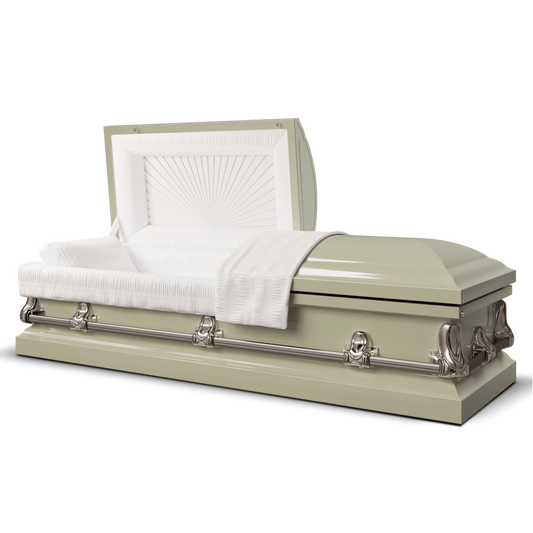
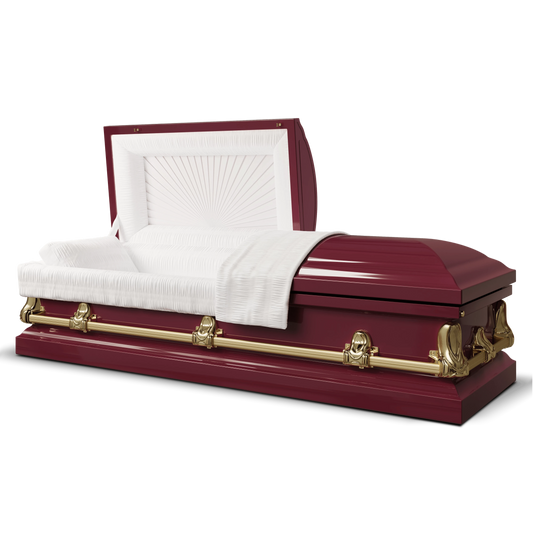
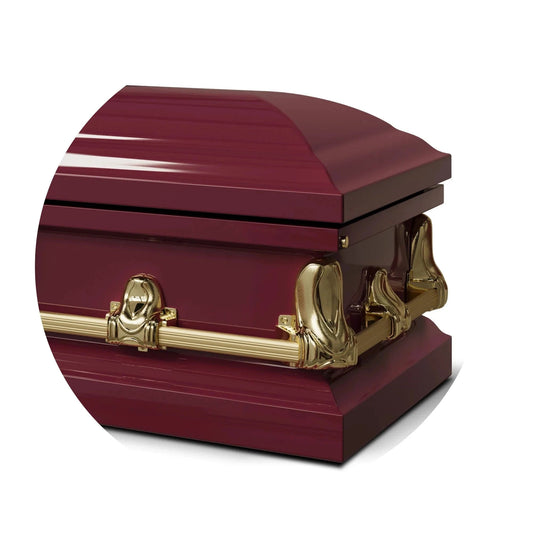
Orion Series (Made in USA)
Sale price
$1,599
Orion Series (Made in USA)
Sale price
$1,599
Orion Series (Made in USA)
Sale price
$1,599

Why Does Rigor Mortis Happen?
The mechanism is the same one that makes muscles work in life, run in reverse. Every muscle contraction involves myosin filaments pulling on actin filaments, and every relaxation requires a fresh molecule of ATP to detach the two. While the heart beats, cells make ATP continuously from oxygen and glucose. When breathing and circulation stop, cells switch briefly to anaerobic metabolism, which produces a small amount of ATP and a large amount of lactic acid, then exhaust that too.
As ATP runs out, two things happen at once. Calcium, which is normally pumped out of the muscle fiber after each contraction, leaks back in and triggers the actin and myosin to bind. And with no ATP available to release them, they stay bound. The fiber is now locked. Because this happens across millions of fibers in each muscle, the muscle as a whole becomes rigid. The falling pH from lactic acid accelerates the process, which is why muscles that were working hard just before death, and so were already acidic, stiffen faster.
Rigor ends not because the muscle relaxes but because the muscle decays. Enzymes released from the dying cells, a process called autolysis, begin digesting the proteins that make up the filaments. Once the actin-myosin bridges are broken down, the stiffness is gone for good. This is the first stage of the longer process described in our guide to how long a body takes to decompose.
What Speeds Up Or Slows Down Rigor Mortis?
The two-to-six-hour figure is an average, and forensic examiners are careful to treat it as one. Several factors move it:
- Temperature. Heat accelerates every chemical reaction involved, so a body in a hot room or in summer conditions may be fully rigid within a few hours and limp again within a day. Cold does the opposite: in near-freezing conditions rigor may not begin for a day or more and can last for days once it does. In a body that is frozen, rigor is effectively paused until it thaws.
- Physical exertion before death. Muscles that were already depleted of ATP, for instance after a struggle, a seizure, or strenuous exercise, enter rigor almost immediately and can do so unevenly.
- Fever or infection at the time of death. A higher body temperature and higher metabolic rate both bring rigor on faster.
- Body size and muscle mass. Infants, the elderly and people with very little muscle mass develop weaker, shorter-lived rigor, sometimes so slight it is hard to detect. Heavily muscled bodies develop more pronounced and longer-lasting rigor.
- Cause of death. Deaths involving convulsions, electrocution or certain poisons such as strychnine produce rapid, intense rigor. Deaths after prolonged illness, where the body is already wasted, produce less.
Because of these variables, rigor mortis on its own can only place the time of death within a window of several hours. Investigators combine it with body temperature, lividity, stomach contents and, later, insect activity to narrow the estimate.
Rigor, Livor And Algor Mortis: The Three Signs Compared
Rigor mortis is one of three early postmortem changes that run on overlapping clocks. Together they are the standard tools for estimating how long ago someone died in the first two days.
Algor mortis is the cooling of the body. Once the heart stops, the body loses heat to its surroundings at a roughly steady rate until it matches the ambient temperature. In a temperate room that rate is on the order of 1.5°F (a little under 1°C) per hour for the first several hours, then slower as the gap narrows. It begins immediately and is usually the first sign an examiner measures, using a core temperature reading.
Livor mortis, also called lividity or hypostasis, is the purple-red discoloration that appears where blood settles under gravity. With circulation stopped, red blood cells drift to the lowest parts of the body and show through the skin. It becomes visible within twenty to thirty minutes, is obvious by two hours, and "fixes" at around eight to twelve hours, meaning that after that point the pattern will not shift if the body is moved. Areas pressed against a surface, such as the shoulder blades of someone lying on their back, stay pale because the pressure prevents blood from pooling there. Lividity that does not match the position a body was found in tells investigators the body was moved.
Rigor mortis, as described above, begins at two to six hours, peaks at around twelve, and resolves at thirty-six to forty-eight.

A body examined at the four-hour mark, then, would typically be cool to the touch but not cold, show lividity that still blanches under pressure, and have a stiff jaw with limbs that still move freely. At twenty-four hours it would be close to room temperature, with fixed lividity and full-body rigor. At seventy-two hours all three signs have played out and examiners rely on the later changes of decomposition instead. Our guide to the signs of death covers the changes that come before this point, in the final hours and days of life.
How Funeral Homes Handle Rigor Mortis
Rigor mortis is a routine part of a funeral director's work rather than a complication. When a body arrives at the funeral home, usually within the window when rigor is present, the embalmer relieves it by gently flexing and massaging each major joint: rotating the head, bending the arms at the elbow and shoulder, flexing the fingers, and working the hips and knees. This mechanical action breaks the locked filaments and the stiffness does not return. It is done before embalming because a rigid body resists the flow of embalming fluid through the vessels, and before dressing because clothing cannot otherwise be fitted.
The jaw and the eyes are addressed separately. The mouth is closed and the jaw is set with a small suture or a mouth former so that the face holds a natural expression, and the eyelids are closed over small caps that keep them in place. Both of these are done while rigor is still present in the face, because it helps the features stay where they are placed.
If a body is being prepared at home for a natural burial without embalming, the same principles apply: gentle repositioning while the body is still supple in the first hours, or after rigor has passed, is far easier than trying to move rigid limbs. Our guide to preparing a body for burial at home walks through the steps. Families who would rather have professional support with those arrangements can get free funeral planning help through Titan Concierge, whose funeral concierge services coordinate directly with the funeral home.
What Rigor Mortis Is Not
Two things are often confused with rigor mortis.
Cadaveric spasm is an instantaneous stiffening of a specific muscle group at the moment of death, without the usual relaxed period first. It is rare, is associated with sudden violent deaths, and classically fixes whatever the person was gripping at the time, such as a weapon or a handful of vegetation. Unlike ordinary rigor it does not spread through the body in sequence, and it passes directly into the normal rigor process rather than resolving separately.
Postmortem movement, the small shifts in limb position that can occur hours after death, is not muscle activity. It is the result of rigor developing or resolving unevenly, of gases accumulating in the abdomen during early decomposition, or of tissues drying and contracting. The stories of a body "sitting up" in a morgue are, where they have any basis at all, exaggerations of these small passive movements. Nothing in rigor mortis involves the nervous system, which stops functioning within minutes of the heart.
Frequently Asked Questions
How soon after death does rigor mortis set in?
Usually within two to six hours, starting in the eyelids, jaw and neck. The whole body is typically rigid by about twelve hours.
How long does rigor mortis last?
It holds for roughly eighteen to thirty-six hours after it is fully established, then fades over the following hours. By thirty-six to forty-eight hours after death, in ordinary room conditions, it has passed completely. Cold storage extends this by days.
Does rigor mortis happen to everyone?
Yes. It is a chemical process in muscle tissue and occurs in every human and animal body. It is weaker and shorter in infants, the very elderly and people with very little muscle, and it can be difficult to detect in those cases, but it still happens.
Can rigor mortis be reversed?
Once broken, either by a funeral director flexing the joints or by the muscle proteins decomposing, it does not return. It cannot be prevented, but refrigeration slows its onset considerably.
Is rigor mortis painful?
No. It occurs after death, when there is no nervous system activity and no sensation.
What happens to the body after rigor mortis passes?
The body becomes limp again and the longer process of decomposition continues. What that looks like over months and years, inside a casket, is covered in our guide to what happens if you open a casket after 10 years.
Sources: Evaluation of Postmortem Changes, StatPearls, National Library of Medicine.