

Introduction
For more than thirty years Fred Rogers walked through the same door, changed into the same cardigan and talked to children as though each of them were the only person watching. He died on 27 February 2003 at his home in Pittsburgh, aged 74, of stomach cancer. The illness had been known to the people who worked with him for barely a month.
His funeral was over within two days, it was private, and nothing about it was released. The public farewell came two months later in a concert hall, and the casket he was buried in has never been described by anyone.

The Life and Legacy of Fred Rogers
Rogers was born in Latrobe, Pennsylvania, on 20 March 1928, and the town stayed close to him all his life. He studied child development at the University of Pittsburgh and took a Master of Divinity at Pittsburgh Theological Seminary, and in 1963 the Presbytery of Pittsburgh ordained him with a charge unlike any other in the denomination, to carry on a ministry to children and families through the media. He never led a congregation. He went into television instead, first on a Pittsburgh children's programme at WQED and then in Canada, before Mister Rogers' Neighborhood began going out nationally on 19 February 1968.
The programme ran for 33 seasons and close to a thousand episodes, and he wrote more than two hundred songs for it, figures set down in the resolution the House of Representatives passed after he died. He was working in the same decades as Lucille Ball and Betty White, though almost nothing about his television resembled theirs. He taped the last episode in December 2000 and it aired in August 2001, then came back out of retirement in September 2002 to record short films helping parents talk to their children about the anniversary of the attacks of the year before. On 9 July 2002 George W. Bush gave him the Presidential Medal of Freedom in the East Room of the White House, telling the room that Rogers had proved television could soothe the soul and teach the very young.
Let Titan Concierge help you plan with clarity, care, and confidence.
The News of Fred Rogers' Passing
His colleagues only learned he was ill in January 2003, shortly before he went in for surgery. Current, the trade paper of American public broadcasting, reported that he spent weeks in hospital and then came home, which was what he wanted, and quoted his production director Sam Newbury saying they had all hoped he would get better and he did not. He died early on 27 February at his house in Pittsburgh, with his family around him.
The cause was stomach cancer, recorded in the congressional tribute passed the following week and carried by the Associated Press on the day he died. He was 74. Cancer also took Patrick Swayze, Audrey Hepburn, Michael Landon and Alex Trebek, and in Rogers's case the whole of it, from the news reaching his colleagues to the funeral, ran from one winter month into the next.
The Funeral Arrangements for Fred Rogers
The funeral was held on Saturday 1 March 2003, two days after he died, and it was private. The Associated Press reported only that it had taken place, and Current described it as a small private ceremony. No church, no minister, no order of service and no attendance figure has ever been released, and an ordained Presbyterian minister went into the ground without a word of it reaching the public.
No funeral instructions of his own have ever been made public either, so there is nothing to say about what he asked for. Others did leave something behind. Elizabeth Taylor left written instructions for her own funeral, and Luke Perry had decided in advance how he wanted to be buried, the sort of thing that gets settled through casket pre-planning or a wider funeral plan.
The Casket Details of Fred Rogers
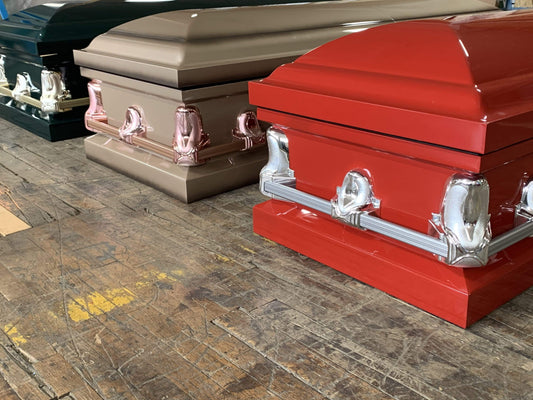
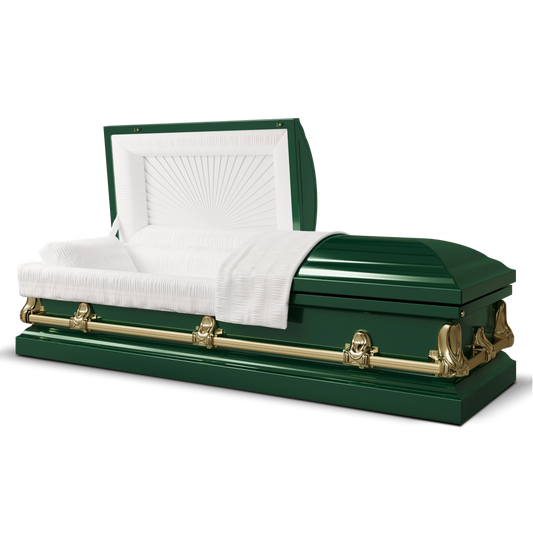
Rogers was buried rather than cremated, so there was a casket, and not one thing about it is on the record. No maker, no model, no wood, no metal, no colour, no lining. A casket becomes a matter of public record only when the service is open or the family chooses to describe it afterwards, and the Rogers family did neither. The shapes and materials a funeral in 2003 would have been choosing between are set out in our guide to celebrity casket types, alongside our caskets, coffins and cremation urns.
What can be described is the ground. He lies in the family mausoleum high on a hill in Unity Cemetery, a few miles from the house he grew up in, a position the Pittsburgh Tribune-Review described as looking out over the community. The cemetery covers about two hundred acres in Unity Township, outside Latrobe, and Mary Lou Townsend of the Latrobe Area Historical Society told CBS News Pittsburgh that his parents and grandparents are buried there too. A casket nobody can describe and a grave anyone can visit is the same combination that followed Jackie Robinson and Mary Tyler Moore.
Attendees and Eulogies
Nobody who went to the funeral on 1 March has ever been named in public. He was survived by his wife Joanne, their two sons and two grandsons, and the congressional tribute passed three days later sent the condolences of the House to them. Beyond that the family kept the day to itself.
The public service came in May 2003 at Heinz Hall, home of the Pittsburgh Symphony, and the Associated Press reported that about two thousand people filled it for a ninety minute memorial arranged by Family Communications, the company that made his programme. His son John Rogers quoted Ralph Waldo Emerson on what it means to succeed, including the line about knowing that one life has breathed easier because you have lived. Teresa Heinz, a board member of the company, said he had personified friendship to a generation of children. Pat Mitchell, then president of PBS, played a tape of Rogers testifying to the Senate in the early 1970s about money for public television. Yo-Yo Ma, who could not be there, sent a filmed tribute, and the violinist Itzhak Perlman, in Pittsburgh for a symphony date and told about the memorial at the eleventh hour, stood up and played Bach.
The Impact on Fans and the Industry
Three days after he died the House of Representatives took up a resolution honouring him, brought by Mike Doyle of Pennsylvania and spoken to by members from Illinois, Texas, Connecticut, Wisconsin and both parties in his own state. They read his life into the record, from the Latrobe childhood to the Medal of Freedom, and sent their condolences to his family. For a presenter of a children's programme that is an unusual thing, and it happened within seventy two hours.
The smaller tributes said as much. Current reported that a trolley service in Harrisburg gave children free rides and collected donations for the Fred Rogers Fund, that preschoolers from a Montessori school in Cincinnati carried a handmade banner to their public television station, and that PBS stations rebroadcast the programme while the network posted advice for parents on how to explain his death to a child. Jim Henson, another figure from children's television, left the same kind of gap when he died.
Legacy and Remembering Fred Rogers
The largest memorial to him sits on the Pittsburgh riverfront. Tribute to Children, a bronze by Robert Berks that stands ten feet ten inches and weighs more than seven thousand pounds, was unveiled on the North Shore on 5 November 2009 in front of several hundred people, with Joanne Rogers there alongside the mayor of Pittsburgh and the chief executive of Allegheny County. Cordelia S. May commissioned it after his death and gave it to Family Communications, and it was set on the stone pier of the old Manchester Bridge, where the seated figure leans forward to tie a shoe and looks across at the city.
Latrobe keeps its own. There is a statue of him on a bench in James Hillis Rogers Memorial Park, and a case at the high school he attended holding his puppets, one of his sweaters and a minister's robe. Two miles from the cemetery, the Fred Rogers Institute at Saint Vincent College holds the Fred Rogers Archive, more than twenty two thousand items from his life and work, which is a fuller account of the man than any marker on a hillside could carry.
-
Catima's Choice
Orion Series (Made in USA)
Regular price $1,599Regular priceUnit price per -
Orion Series (Made in USA)
Regular price $1,599Regular priceUnit price per -
Orion Series (Made in USA)
Regular price $1,599Regular priceUnit price per


Conclusion
Fred Rogers was buried two days after he died, in a ceremony small enough that not one person who attended it has ever been named. The casket is a blank. The grave is not, and it sits on a hill above the town where he was born, in the mausoleum that already held his parents and his grandparents.
Two months later two thousand people sat in a concert hall in Pittsburgh and listened to Bach, to a son reading Emerson, and to a tape of a man in a cardigan explaining to senators why children deserved better television. The distance between the quietest possible funeral and the size of that farewell is the shape of how Fred Rogers was mourned.
Sources
- Associated Press, obituary and key events in the life of Fred Rogers, 27 February 2003, carried by the Deseret News
- Associated Press, report of the Heinz Hall memorial, May 2003, carried by the Southeast Missourian and The Vindicator
- Current, the newspaper of American public broadcasting, March 2003
- Congressional Record, House of Representatives, 4 March 2003, H. Res. 111
- The White House, Office of the Press Secretary, remarks at the presentation of the Presidential Medal of Freedom, 9 July 2002
- Pittsburgh Tribune-Review, Fred Rogers' lasting legacy and continuing ties to his Latrobe home, by Deb Erdley
- CBS News Pittsburgh, report on burials at Unity Cemetery, June 2024
- WTAE-TV, report on the unveiling of the Fred Rogers sculpture, November 2009
- Presbyterian Historical Society, Presbyterian Church (U.S.A.), Remembering Mr. Rogers
- Fred Rogers Institute, Saint Vincent College
- Tribute to Children, official site of the Fred Rogers Memorial Statue
Image credits
Tribute to Children (2009) by Robert Berks, Mr. Rogers Statue, North Shore, Pittsburgh, Pennsylvania, September 2022. Photograph by Ron Cogswell, published on Flickr under a Creative Commons Attribution 2.0 Generic licence, https://creativecommons.org/licenses/by/2.0/.