

![Upgrade to Premium Weight [18-gauge steel]](http://titancasket.com/cdn/shop/products/casketthicknesswithnumbers.png?v=1680642906&width=533)

If your loved one served as a firefighter, you may want their funeral to reflect that service. A firefighter funeral can be anything from a private family service with a few fire-service touches to full department honors with apparatus, an honor guard, bagpipes and a bell ceremony. This guide covers what each of those involves, and what a family is entitled to ask for.
What Does LODD Mean?
LODD stands for line-of-duty death. In the fire service it refers to a firefighter who dies as a direct result of performing fire department duties. That covers deaths at an emergency incident, deaths during training or while responding to or returning from a call, and deaths from an illness or injury that arose out of duty (a cardiac event following a fire, for example, or an occupational cancer).
The term matters practically as well as ceremonially. A death classified as a LODD normally triggers full department honors, and it opens access to survivor benefits and to formal support programs that an ordinary retirement death does not. The precise criteria used for federal survivor benefits are narrower than the general fire-service usage, so departments confirm the classification through the National Fallen Firefighters Foundation and the relevant benefits programs rather than assuming.
What Is a Fireman's Funeral?
How formal the service becomes depends mainly on two things: how the firefighter died, and their standing in the department.
Line-of-duty death. The funeral is typically very formal, with full honors closely modelled on a military ceremony.
Active or uniformed member who did not die in the line of duty. Full honors are still normally offered, with the same military-style recognition of the member's service.
Retired, inactive, honorary members and spouses. This is left to the individual department. There is no rule for or against full honors, and many departments extend them readily when the family asks. If honors matter to you, ask. Departments will rarely offer unprompted for an affiliate member.
Families can also decline all of it. A private funeral is always an option, whatever the circumstances of the death, and choosing one is not a slight on the department.
Plan Your Farewell with Grace – Our Pre-Planned Caskets Offer Peace of Mind
What Is a Firematic Service?
A firematic service is the fire-service ceremonial portion of the funeral, as distinct from the religious or civil service itself. It is the part the department runs: the honor guard, uniformed pallbearers, the apparatus, the bell ceremony, the walk-through and the final salute.
The two are usually combined into a single day: a firematic service at the funeral home or station, followed by the religious service, followed by the procession to the cemetery. Departments will coordinate the sequence with the funeral director, so the family generally only needs to say what they do and do not want included.
Fire Department Funeral Procedures
Procedures vary between departments, but most follow a recognisable order:
- Notification and liaison. The department appoints a liaison officer to work with the family. For a line-of-duty death, the state Local Assistance State Team (LAST) may also be activated to help with funeral arrangements and benefits filing.
- Family consultation. The family decides the level of honors, who speaks, whether apparatus is used, and whether the service is open to the wider fire service.
- Watch or vigil. An honor guard may stand watch over the casket during visitation, rotating at set intervals.
- Firematic service. Honor guard, uniformed pallbearers, bagpipes, and often a bell ceremony marking the member's last call.
- Procession. Apparatus escort to the cemetery, sometimes with the casket carried on an engine or a caisson.
- Graveside honors. Final salute, presentation of the flag or helmet to the family, and last radio call.
Departments do not have to invent this from scratch. The NFFF maintains a library of LODD standard operating procedures collected from departments across the country, including the IAFF funeral protocol for line-of-duty deaths.
How Do You Honor Fallen Firefighters?
Apparatus. An engine or ladder truck in the ceremony, or an escort of department vehicles in the procession. Some departments carry the casket on an engine.
Honor guard and pallbearers. Members of the department in dress uniform, serving as pallbearers or as a color guard.
Badge shrouds. Members wear a black band across their badge, traditionally for a set mourning period after the death.
Bagpipes and bugle. Pipes lead the casket in or out; a bugler may play as well. The tradition traces back to Irish and Scottish immigrant firefighters in nineteenth-century American cities.
The bell. A bell ceremony signals the firefighter's last call, historically the signal that a company had returned safely to quarters.
Crossed ladders. Two aerial ladders raised to form an arch, often with a flag suspended between them, at the station, the funeral home or the cemetery entrance.
Black bunting. Draped on stations and apparatus, usually alongside a sign naming the member who has died.
A caisson. Departments with the equipment may use a horse-drawn wagon to carry the casket, typically flag-draped.
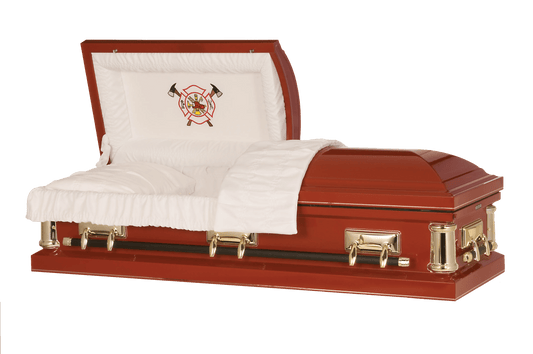
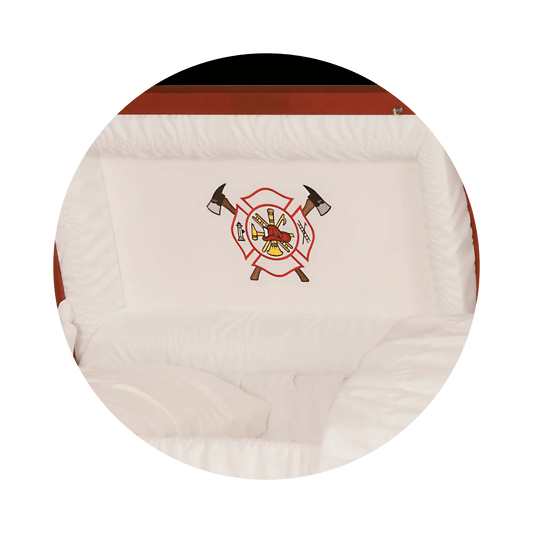
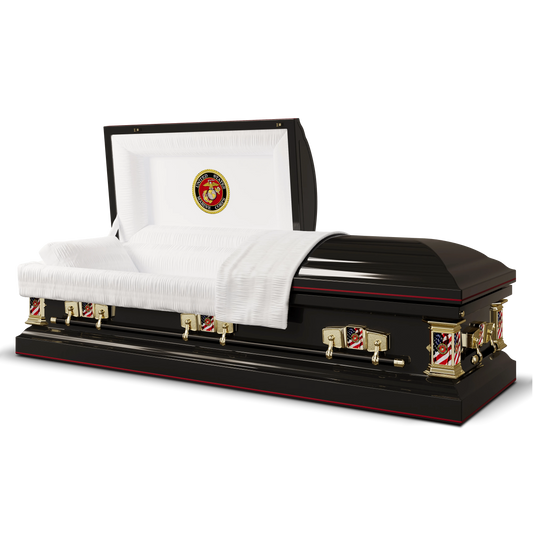
The casket itself. Some families choose a casket that reflects the service. Our Firefighter casket ($2,499) is a red steel casket with a white interior and firefighter imagery, made in the USA.
Firefighter (Made in USA)
Sale price
$2,499
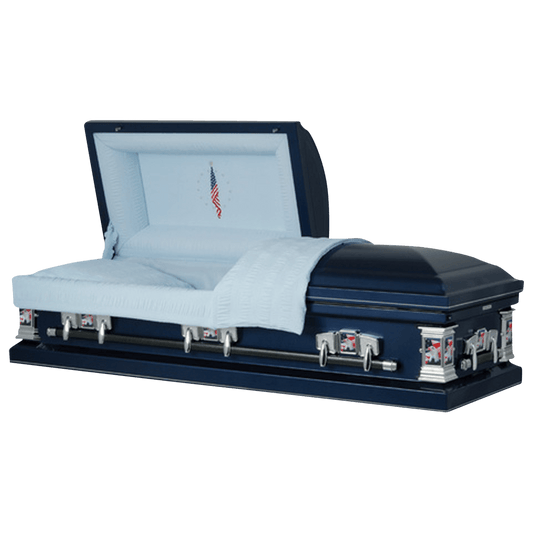
Veteran Premier (Made in USA)
Sale price
$2,299
What Is the Fireman's Prayer?
The Fireman's Prayer is generally attributed to A. W. "Smokey" Linn, a Kansas firefighter, who is said to have written it in 1958 after being unable to save three children trapped in a burning building. It asks that a higher power help firefighters hear the calls of those who need them, and that their families be provided for if they are injured or killed in the line of duty.
Families often choose to have it read at the service. The reading can be done by a family member, a friend, a fellow member of the department, or a fire chaplain.
Other Ways to Honor a Departed Firefighter
Many departments host a gathering with refreshments after the service, a wake or reception where members, family and friends can talk and begin to absorb what has happened. For many firefighting families this is the part that carries the most weight.
Beyond the funeral itself, families sometimes establish a memorial fund, request donations to a burn foundation or fire service charity in place of flowers, or arrange for the firefighter's name to be added to a state or national memorial.
Where to Get Help Planning a Firefighter Funeral
For a line-of-duty death, start with the department liaison officer and the National Fallen Firefighters Foundation, which coordinates state Local Assistance State Teams to help families with funeral arrangements and benefits filing at no cost. The NFFF survivor benefits guide sets out what a family may be entitled to.
For a retirement or non-duty death, the department may still offer honors but the practical arrangements fall to the family. If you are handling the cemetery, the service and the paperwork yourself, Titan Concierge offers free funeral planning guidance, and our general guide to planning a funeral covers the steps that apply to any service.
On the casket, one thing worth knowing: under the FTC Funeral Rule a funeral home must accept a casket you bought elsewhere and cannot charge you a handling fee for it. Titan Casket sells direct, so a family arranging honors through the department can still choose and price the casket independently. If you want help thinking it through, our funeral concierge services are free to use.