

![Upgrade to Premium Weight [18-gauge steel]](http://titancasket.com/cdn/shop/products/casketthicknesswithnumbers.png?v=1680642906&width=533)

Short answer: Planning a funeral involves eight steps, usually compressed into three to seven days: obtain the death certificate, decide burial or cremation, choose a funeral home, request their General Price List, select a casket or urn, set the date and venue, arrange the service details, and notify family and friends. The single biggest saving available to most families is buying the casket independently rather than through the funeral home.
The Funeral Planning Timeline
| When | What needs to happen |
|---|---|
| First 24 hours | Obtain legal pronouncement of death. Arrange transport of the body. Notify immediate family. Locate any pre-planning documents or will. |
| Days 1 - 2 | Choose burial or cremation. Select a funeral home and request their General Price List. Begin the death certificate application. |
| Days 2 - 3 | Choose the casket or urn. Set the date, time and venue. Decide on burial plot or cremation arrangements. |
| Days 3 - 5 | Write and publish the obituary. Arrange officiant, music, readings, flowers and transport. Confirm pallbearers. |
| Days 3 - 7 | Hold the viewing or wake, then the funeral service and committal. |
| Following weeks | Order certified death certificate copies. Notify Social Security, banks and insurers. Order the headstone once ground settles. |
If this is happening now and the timeline feels impossible, professional funeral planning services can take the arrangements off your hands - Titan Concierge handles both at-need and pre-need planning and can start the same day.
Step 1: Obtain the Death Certificate
Almost nothing else can proceed without it. Burial and cremation permits both depend on the death certificate, and banks, insurers and Social Security will each want certified copies. The funeral home usually files the paperwork on your behalf. Order more copies than you think you need - ten is a reasonable starting point, since most institutions will not accept a photocopy. Our guide to getting a death certificate covers the process state by state.
Step 2: Decide Between Burial and Cremation
This decision drives everything downstream - the cost, the timing, and the type of container you need. If the person left written wishes or pre-planned, follow those. Cremation is now the majority choice in the United States and is generally the less expensive route, though a cremation with a full service costs more than many families expect.
Step 3: Choose a Funeral Home and Get the Price List
Contact several. Prices for identical services vary widely between providers in the same town, and there is no premium attached to being expensive.
Always ask for the General Price List before you discuss anything else. The FTC Funeral Rule requires every funeral home to give you an itemised written price list on request, and to let you buy only the items you want. Ask for the General Price List up front and before mentioning that you may source a casket elsewhere, so the quoted prices for other services are not adjusted.
Step 4: Choose the Casket or Urn
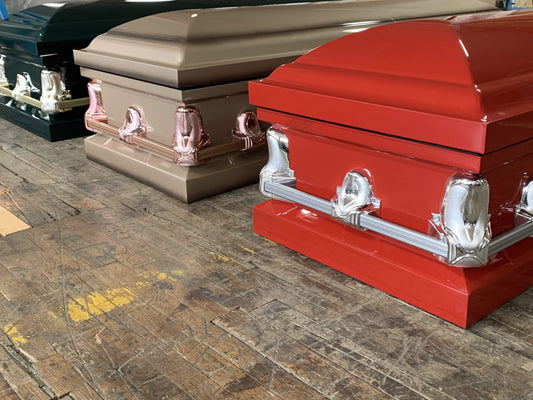
This is where most families overpay. Funeral homes typically mark caskets up substantially, and federal law requires them to accept a casket you have bought elsewhere - they cannot charge you a handling fee for doing so.
Buying a casket online from a direct retailer usually costs considerably less than the funeral home's price for a comparable model, with free delivery. Consider whether you need a gasketed casket at all - a non-gasketed model is cheaper and, as our guide to decomposition timelines explains, sealing changes the pace of a natural process rather than preventing it.
-
US Army
Veteran Select (Made in USA)
Regular price $2,499Regular priceUnit price per -
Atlas XL (Made in USA)
Regular price From $1,999Regular priceUnit price per -
Pillar (Poplar) (Made in USA)
Regular price $1,999Regular priceUnit price per






Step 5: Set the Date, Time and Venue
Funerals are usually held three to seven days after death, though religious tradition can shorten that considerably. Services can be held at a funeral home, a house of worship, a graveside, or at home. Consider how far family must travel before fixing a date.
Step 6: Arrange the Service Details
Officiant, eulogies, readings, music, flowers, order of service, transport and pallbearers. If you want a celebration of life rather than a traditional service, this is the point to shape it.
Step 7: Write and Publish the Obituary
Newspaper obituaries are charged by the line and costs add up quickly. Our guide to obituary costs covers the pricing. Online obituaries through the funeral home are usually free and reach more people.
Step 8: Handle the Administration
After the service: notify Social Security, contact life insurers, close or transfer accounts, and begin probate if needed. Order the headstone once the cemetery confirms the ground has settled, usually six to twelve months on.
Funeral or Memorial - What's the Difference?
Both serve the same purpose: to formally say goodbye. The difference is the body. At a funeral, the body is present, lying in repose in a casket that may be open or closed, which is why funerals happen within about a week. At a memorial, the body is not present, so it can be held at any time and in any place - months later, or on an anniversary.
They are not mutually exclusive. Many families hold a small private funeral followed by a larger public memorial. A wake is a social gathering held before the funeral, usually at the funeral home. A viewing - also called calling hours or visitation - is time set aside for people to pay respects to the body, with guests coming and going as they wish.
How to Save on Funeral Costs
- Buy the casket independently. The largest single saving available, and funeral homes are legally required to accept it.
- Skip the gasket. A non-gasketed casket costs less and sealing offers no meaningful preservation benefit over time.
- Choose a grave liner over a vault. Most states do not require an outer container at all, though many cemeteries do. Where one is needed, a liner is cheaper than a sealed vault.
- Reconsider the venue. A graveside service, home service or memorial costs far less than a full funeral home service.
- Shop flowers away from florists. Grocery stores and online retailers are considerably cheaper. In-season blooms and silk arrangements cost less again.
- Decline what you do not want. Under the Funeral Rule you buy only the individual items you choose. Nothing beyond basic services is mandatory.
If you would rather not negotiate any of this while grieving, Titan Concierge offers free funeral planning guidance and will handle the comparison and arrangements for you.
Planning a Funeral in Advance
Pre-planning removes the hardest decisions from grieving relatives and locks in today's prices. It is worth doing for four things in particular.
Choose the funeral home early
Compare several providers with no time pressure, visit the ones you shortlist, then enter a contract to fix the price. Ask for the General Price List exactly as you would at need - the same rules apply. Choosing a local funeral home covers what to look for.
Secure the casket or urn
Buying ahead gives you the choice you actually want rather than whatever is available on 48 hours' notice. It also allows for arrangements that are impossible to organise at need - spouses wanting matching caskets, for instance.
Reserve the burial or memorial location
Cemetery plots can be bought in advance, often as a pair. Our guide to choosing a final resting place walks through the options, including mausoleum entombment.
Document your wishes
Write down what you want: burial or cremation, the type of service, religious or cultural traditions to observe, music, readings. Families consistently describe this as the most valuable thing a person can leave them. Store it somewhere findable and tell someone where it is.
Let Titan Concierge help you plan with clarity, care, and confidence.
Frequently Asked Questions
-
How do you plan a funeral step by step?
Answer: Obtain the death certificate, decide burial or cremation, choose a funeral home and request their General Price List, select a casket or urn, set the date and venue, arrange service details, publish the obituary, then handle the administration afterwards.
-
How long does it take to plan a funeral?
Answer: Most funerals are arranged in three to seven days. Religious tradition can compress this to 24 hours, while a coroner investigation or international travel can extend it to two weeks or more.
-
What is the biggest way to save money on a funeral?
Answer: Buying the casket from an independent retailer rather than the funeral home. Federal law requires funeral homes to accept a casket you supply and prohibits them charging a handling fee for it.
-
Do I have to use a funeral home?
Answer: No. All US states permit family-directed funerals and at-home body care, though the specific requirements vary. A funeral home is usually simpler, but it is not legally required.
-
What is a General Price List?
Answer: An itemised written list of every service and its price, which the FTC Funeral Rule requires funeral homes to provide on request. Ask for it before discussing anything else, and before mentioning that you may source a casket elsewhere.
-
Should you plan a funeral in advance?
Answer: It removes difficult decisions from grieving relatives and locks in current prices. The four things worth arranging early are the funeral home, the casket or urn, the burial location, and a written record of your wishes.
At Titan Casket, families can find high-quality caskets and urns with full customization options. And with our funeral concierge services, you get personalised planning designed to fit your budget and priorities.